By Mike Rux · Published January 7, 2026 · Updated July 31, 2026
TL;DR, Key takeaways
- Link building is the process of earning links (backlinks) from other websites to yours. Search engines and AI answer engines both treat them as trust signals.
- Backlinks still matter in 2026. Ahrefs finds a positive correlation between the number of sites linking to a page and its search traffic.
- Audit before you build. Old directory spam and over-optimized anchors can drag a local site down.
- For local businesses, a handful of relevant local links usually beats hundreds of random ones.
- AI search raises the stakes: Semrush’s research shows AI systems consistently favor domains with strong backlinks, authority, and visibility.
If you run a local business, link building can feel confusing, risky, and slow. You’ve heard you need backlinks to rank, but nobody tells you which links help, which hurt, or what a sane strategy looks like now that AI Overviews sit on top of the search results. This guide breaks it down in plain English, the same approach we use for clients across the East Valley and beyond.
What is link building?
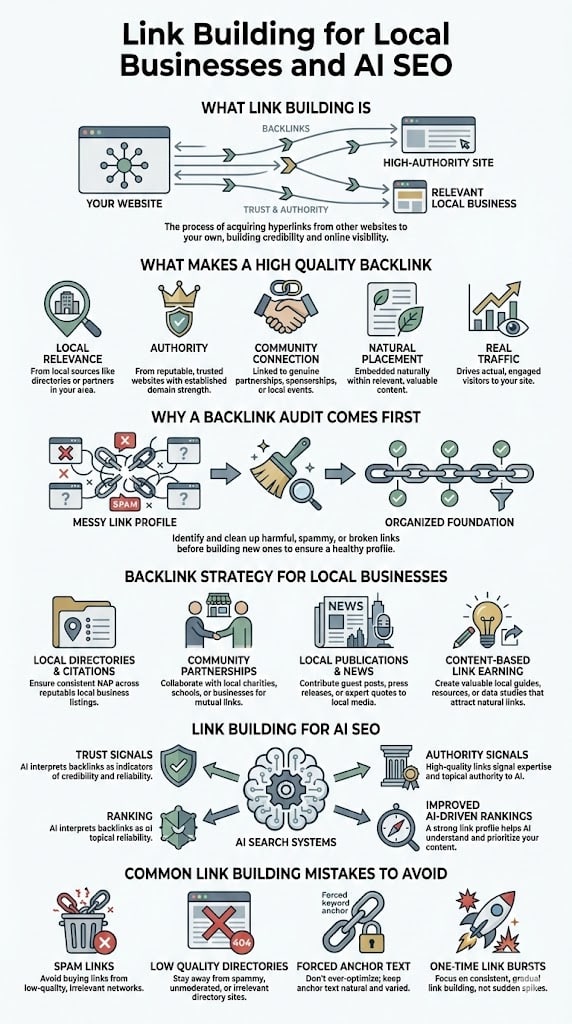
Link building is the process of earning links from other websites that point to your website. Those links are called backlinks, and each one works like a digital recommendation: another site vouching that your business is real, relevant, and worth showing to searchers.
For a local business, backlinks support higher organic rankings, stronger visibility in competitive service areas, and the kind of credibility that helps you stand out from every competitor with a template website. Link building is not about collecting as many links as possible. It’s about earning the right links from the right places in a way that mirrors your real-world reputation.
Do backlinks still matter in 2026?
Yes. Backlinks remain one of the clearest trust signals search engines use, and they now feed AI answer engines too. Ahrefs’ search traffic research found a positive correlation between the number of websites linking to a page and how much search traffic that page earns. Their backlink growth study of 10,000 SERPs also found that most top-ranking pages keep gaining followed backlinks from new websites at a pace of 5% to 14.5% per month (Ahrefs, 2026).
Here’s the honest counterpoint: link building is not the highest-leverage activity for most local sites. In Search Engine Journal’s State of SEO 2026 survey of 371 SEO professionals, only 16.4% cited backlink acquisition among their highest-impact activities, original content creation topped the list at 66.3%. And 38.8% of organizations said link acquisition is among the hardest SEO activities to scale (SEJ, 2025). Links are a multiplier, not a foundation. Build the content worth linking to first, then earn the links. That’s exactly how we sequence it in our Arizona SEO campaigns.
What makes a high-quality backlink?
A high-quality backlink combines trust, relevance, and context, not one magic metric. Here’s what we weigh when we evaluate links for local clients:
| Signal | Why it matters |
|---|---|
| Relevance | A link from a site in your industry or community carries more weight than a random blog. |
| Local connection | Chambers of commerce, sponsorship pages, local publications, and event sites build location authority. |
| Real traffic | A link that can send actual customers is a business asset, not just an SEO play. |
| Natural placement | A link inside a real paragraph beats one dumped in a footer or link list. |
| Linking-site trust | Sites that exist only to sell links can hurt you. Real content, real visitors, real reason to mention you. |
Why should you audit your backlink profile first?
Because building new links on top of a messy profile slows everything down. A backlink audit shows you which sites already link to you, which pages earn links, whether your anchor text looks natural, and whether you’re carrying spam that needs cleanup. Many local sites that have been online for years are dragging around old citations, weird directory links, and legacy SEO work from a previous agency.
There’s a practical reason to prune, too: link profiles decay on their own. Ahrefs found that 66.5% of links to sites created in the last nine years are dead (Ahrefs, 2026). We run backlink audits through Semrush as a standard first step, red flags we look for include links from unrelated websites, obvious spam directories, over-optimized anchors, and sudden link spikes that don’t match any real marketing activity.
What does a local backlink strategy look like?
A strong backlink strategy is a system, not a one-time push. Here’s the four-step approach we use:
1) Build a clean base of trusted listings. Focus on quality over volume: industry-specific directories, local directories with editorial standards, chamber and community sites, and partner directories. The goal is being listed where real customers actually look.
2) Earn local links through real involvement. The easiest local links reflect what your business already does, sponsoring a youth team, partnering with complementary businesses, supporting a local nonprofit, or speaking at community events and getting featured on the host’s website. We’ve spent 15+ years in the Gilbert community, and these relationship-based links have outlasted every algorithm update we’ve seen.
3) Create content that earns links naturally. Local guides, pricing guides that set honest expectations, case studies with real numbers, and how-to articles that prove experience all attract references. This pairs naturally with a content marketing program and with our Hub, Wheel & Spoke content structure, which gives every earned link a well-organized page to strengthen.
4) Use outreach honestly. One real relationship at a time: pitch local publications a genuine story, offer expert quotes, share useful assets like checklists and calculators. No mass email blasts. For context on effort, Ahrefs cites Aira’s State of Link Building data showing SEOs typically spend 1–2 hours building a single link, good links cost time, which is exactly why cheap link packages should make you suspicious.
How does link building help AI SEO?
Link building supports AI search visibility because AI systems lean heavily on authority signals when choosing which businesses to cite. Semrush’s AI Mode comparison research found that AI consistently prioritizes domains with strong backlinks, authority, and visibility, even when it cites different pages than Google’s top organic results (Semrush, 2025). Shopify’s 2026 SEO trends analysis makes the same point: answer engine optimization looks at brand signals like web mentions and the number of reputable domains linking to your site, the more known your brand, the more likely you are to appear in a ChatGPT answer or AI Overview.
Three practical implications for local businesses:
- Consistency counts. Backlinks, brand mentions, and identical business details across the web help AI systems connect the dots about who you are.
- Relevance beats volume. A few strong links from local and industry sources outperform hundreds of random ones.
- Natural anchors beat forced keywords. A healthy profile mixes your brand name, your URL, and plain phrases. Forced exact-match anchors look manufactured, to Google and to us.
For the full picture of how authority signals feed AI answers, see our AI SEO 2026 guide.
Common link building mistakes to avoid
- Buying cheap link packages. Low-quality links create spam signals that are expensive to clean up.
- Submitting to every directory. Many exist only to sell listings.
- Skipping the audit. New links on a toxic profile compound the problem.
- Over-optimizing anchors. Unnatural anchor patterns are one of the fastest ways to get flagged.
- One-time bursts. Steady, consistent earning beats spikes.
- Pointing links at weak pages. Your best links deserve pages built to convert.
How Ciphers Digital Marketing approaches link building
Our approach is built for local businesses that want growth without gambling. We use AI-assisted research to find opportunities faster, but every placement decision is human-reviewed and tied to your market. The process: audit first (existing links, anchors, risk), strategy next (opportunities tied to your industry and location), build assets worth referencing, earn placements that can drive real visibility, then track rankings, traffic, and conversions in reporting you can actually read.
Want a backlink audit and a plan built for your market? Get in touch with our team: call or text (602) 844-8072.
Frequently asked questions
What is link building?
Link building is the process of earning links from other websites to your own. These backlinks act as trust signals that help search engines and AI answer engines judge whether your business is credible, relevant, and worth recommending to searchers in your area.
Do backlinks still matter for SEO?
Yes. Ahrefs’ research shows a positive correlation between referring websites and search traffic, and Semrush’s AI research found AI systems favor domains with strong backlinks and authority. But content comes first: in SEJ’s State of SEO 2026 survey, original content creation (66.3%) far outranked backlink acquisition (16.4%) for impact.
How many backlinks does a local business need?
There’s no magic number. The better question is whether you have more high-quality, relevant backlinks than your top local competitors. A small set of strong local and industry links routinely outperforms a large pile of weak ones.
Can link building hurt my rankings?
Yes, spammy, irrelevant, or purchased links from low-quality networks can suppress rankings and are hard to clean up. That’s why we audit before we build. If you suspect bad links, start with a backlink audit rather than more link building.
What is link building for AI SEO?
It means building the credibility signals AI search systems use to decide which businesses to cite: backlinks from relevant sites, consistent brand mentions and business details, and content that clearly demonstrates first-hand expertise.
Sources
- Ahrefs, “107 SEO Statistics for 2026”, https://ahrefs.com/blog/seo-statistics/ (backlink/traffic correlation; +5–14.5%/month backlink growth; 66.5% link rot; Aira 1–2 hours per link)
- Search Engine Journal, State of SEO 2026 survey (n=371), searchenginejournal.com (16.4% backlink acquisition; 66.3% original content; 38.8% link acquisition hardest to scale)
- Semrush, “AEO vs SEO: Core Differences”, https://www.semrush.com/blog/aeo-vs-seo/ (AI favors trusted, authoritative domains)
- Shopify, “Latest SEO Trends in 2026”, https://www.shopify.com/blog/seo-trends (AEO brand signals)