By Mike Rux · Published July 17, 2025 · Updated July 31, 2026
TL;DR, Key takeaways
- SEO is not dead, it’s being restructured around AI answers. Google AI Overviews now reach 2 billion monthly users (Google, via Semrush).
- Traditional search still dominates referrals: Google sends 345 times more traffic than ChatGPT, Gemini, and Perplexity combined (Ahrefs).
- “GEO” now means two things in marketing: geo targeting (location-based optimization) and generative engine optimization (getting cited in AI answers). Modern local SEO needs both.
- AI search visitors convert well, worth 4.4x more than a traditional organic visitor on average (Semrush).
- The playbook: keep ranking in Google, structure content so AI systems can cite it, and anchor everything to a real, verifiable local presence.
Short answer: absolutely, and here’s why businesses can’t afford to ignore it. Search is being rewritten by AI SEO and generative engine optimization, and the businesses that understand how location signals and AI-driven answers work together will be the ones that stay visible. If you want the step-by-step playbook, our Ultimate Guide to AI SEO 2026 goes deeper on everything below.
Is SEO still relevant in the age of AI?
Yes. SEO remains relevant because search engines are still where most buying journeys start, and because AI answer engines choose their sources from the same authority signals SEO builds. The scale of the shift is real: Gartner predicted traditional search engine volume would drop 25% by 2026 as consumers move to AI-powered search (Gartner, via SEJ). AI search traffic to websites is up 527% year over year (Previsible via Search Engine Land, cited by Semrush).
But context matters. Google still handles roughly 5 trillion searches per year (Search Engine Land, via Shopify), and Ahrefs found Google sends 345 times more traffic than ChatGPT, Gemini, and Perplexity combined (Ahrefs, 2026). Users also double-check the machines: a Kevin Indig study found 80% of users still click through to traditional search results to verify information even when an AI Overview appears (via SEJ, 2025).
So the question was never “SEO or AI?” It’s whether your SEO produces the authority and structure that both Google rankings and AI citations feed on. At Ciphers Digital Marketing, that’s exactly how we build campaigns.
What is GEO, geo targeting or generative engine optimization?
Both, and the overlap is where local businesses win.
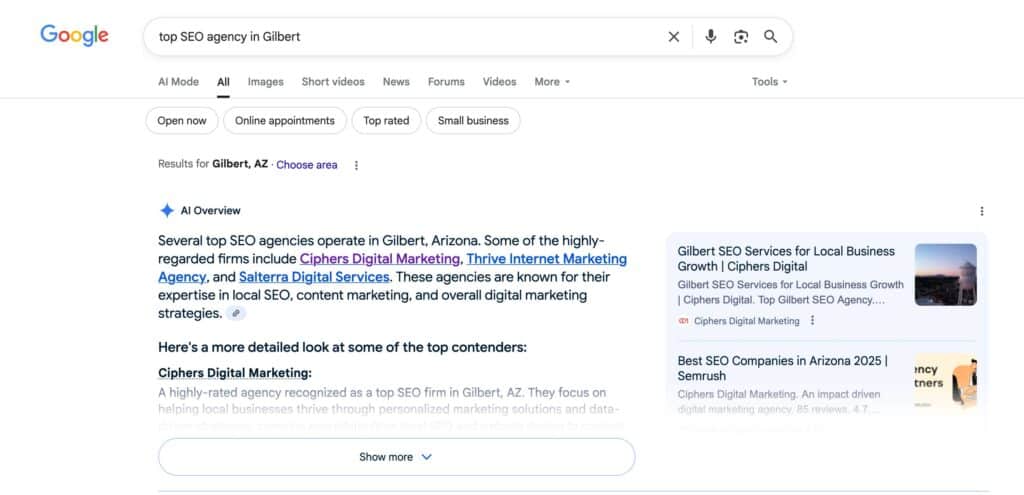
Geo targeting is the practice of optimizing your visibility for searches tied to a specific location, “best plumber near me,” “top SEO agency in Gilbert.” It covers your Google Business Profile, service-area pages, localized content, and location signals like geotagged images.
Generative engine optimization (GEO), per Semrush, “targets the AI ecosystem, including standalone generative AI tools, and focuses on getting content cited and used in AI-generated responses” (Semrush, 2025).
They intersect for one simple reason: when someone asks Google’s AI Mode or ChatGPT “who’s the best garage door company in Mesa?”, the AI has to pick trustworthy local sources. Semrush’s AI Mode research found AI consistently prioritizes domains with strong backlinks, authority, and visibility, the outputs of traditional SEO, even when it cites deeper pages than Google’s top results (Semrush, 2025). Your local authority is your AI eligibility.
How is AI changing search behavior?
The numbers tell a consistent story: fewer clicks, higher-value visitors.
- Google AI Overviews now reach 2 billion monthly users (Google Q2 2025 earnings, via Semrush).
- Roughly 60% of searches on traditional search engines now end without any clicks (Bain & Company, via Semrush).
- When a Google AI summary appears, only 8% of users click a traditional result link, versus 15% without a summary (Pew Research, via Semrush).
- The consolation prize is significant: the average AI search visitor is worth 4.4x more than a traditional organic search visitor (Semrush, 2025). People who click out of an AI answer arrive pre-qualified.
For local service businesses there’s a built-in advantage: BrightEdge found local and purchase-intent searches trigger AI Overviews less often than informational searches (BrightEdge via SEJ, 2024). The “emergency AC repair Gilbert” searcher still sees a map pack and organic results, which is why our Hub, Wheel & Spoke structure keeps city and service pages as the conversion layer while informational content earns AI citations.
What does modern AI SEO actually involve?
Here’s how we combine AI tooling and location data in client campaigns, the practitioner version, not the buzzword version:
- Search intent modeling. We analyze real search behavior in Semrush and GA4 to map how your customers actually phrase problems, then match pages to intent instead of stuffing keywords.
- Semantic clustering. Topic-focused content builds topical authority across your service categories, so both Google and AI engines recognize you as a subject-matter source.
- Answer-first structure. Question-based headings, direct 40–60 word answers, FAQ schema, and clean definitional sentences, the format AI systems extract and cite.
- Location signals. Consistent NAP everywhere, optimized Google Business Profile, city hub pages, and geotagged imagery (we built a free geo image tagging tool because we use this on every local campaign).
- Human review on everything. AI accelerates research and drafts; strategy and final copy stay human. That’s not sentiment, it’s the industry consensus: 58.5% of SEO professionals plan to focus on human-authored content supported by AI tools, versus 22.4% pursuing primarily AI-generated content (SEJ State of SEO 2026).
SEO isn’t dead, it’s just smarter
The businesses losing traffic right now aren’t losing it to AI. They’re losing it to competitors who adapted their SEO for AI. Rankings still matter. Authority matters more. And a real, verifiable local presence, reviews, consistent listings, genuine service-area content, is the moat AI systems can’t ignore when they recommend businesses.
We’ve spent 15+ years building that kind of visibility for Arizona businesses, and our search engine optimization services now bake AI SEO and geo targeting into every campaign rather than selling them as add-ons.
Ready to see where you stand in AI search? Book a strategy call: call or text (602) 844-8072.
Frequently asked questions
What is geo targeting in SEO?
Geo targeting in SEO is optimizing your website and listings to appear for searches tied to specific locations, through service-area pages, Google Business Profile optimization, localized content, and consistent name-address-phone data. It’s how a Gilbert business shows up when someone nearby searches “plumber near me.”
What is generative engine optimization (GEO)?
Per Semrush, GEO is optimization that “targets the AI ecosystem, including standalone generative AI tools, and focuses on getting content cited and used in AI-generated responses.” In practice: structured, answer-first content plus strong domain authority.
Will AI replace SEO?
No. AI answer engines select sources based on the authority, structure, and trust signals that SEO builds, Semrush’s research found AI consistently prioritizes domains with strong backlinks and visibility. SEO and AI optimization are complementary: strong SEO fuels AI citations.
Do AI Overviews affect local businesses?
Less than you’d think, for now. BrightEdge found local and purchase-intent searches trigger AI Overviews less often than informational queries. Local map packs and organic results still drive most service-business leads, while informational content is your entry point into AI answers.
Sources
- Semrush, “26 AI SEO Statistics for 2026”, https://www.semrush.com/blog/ai-seo-statistics/ (2B AI Overview users; +527% AI search traffic; 4.4x visitor value; ~60% zero-click; 8% vs 15% CTR)
- Semrush, “AEO vs SEO: Core Differences”, https://www.semrush.com/blog/aeo-vs-seo/ (GEO definition; AI favors authoritative domains)
- Ahrefs, “107 SEO Statistics for 2026”, https://ahrefs.com/blog/seo-statistics/ (Google sends 345x more traffic than ChatGPT, Gemini, Perplexity combined)
- Shopify, “Latest SEO Trends in 2026”, https://www.shopify.com/blog/seo-trends (~5 trillion Google searches/year, citing Search Engine Land)
- Search Engine Journal, “SEO in the Age of AI” (2024) and “SEO Trends 2026” / State of SEO 2026 survey, searchenginejournal.com (Gartner -25% prediction; Kevin Indig 80% verification clicks; BrightEdge local-trigger finding; 58.5% human-authored content plan)