By Mike Rux · Published July 22, 2025 · Updated July 31, 2026
TL;DR, Key takeaways
- Hub, Wheel & Spoke is Ciphers Digital Marketing’s content structure for local service businesses: city hub pages, deep service spoke pages, and deliberate internal linking (the wheel) connecting them.
- It replaces the old “one page for every service in every city” playbook, which creates duplicate content, keyword cannibalization, and wasted crawl budget.
- Internal linking is quietly one of SEO’s highest-leverage activities: 22.9% of SEO professionals rank it among their highest-impact work (SEJ State of SEO 2026).
- The structure compounds: Ahrefs finds the average top-ranking page also ranks in the top 10 for nearly 1,000 other keywords.
- The same architecture that wins local rankings feeds AI Overviews and AI Mode, because AI systems reward clear topical authority.
Local SEO success doesn’t come from a single page. It comes from a system of content that works together. At Ciphers Digital Marketing, we call that system the Hub, Wheel & Spoke strategy, it’s the structure behind our own site (the one you’re reading right now) and the client campaigns in our case studies. This is the full breakdown of how it works and why it keeps working in the AI search era.
What is a hub and spoke content strategy?
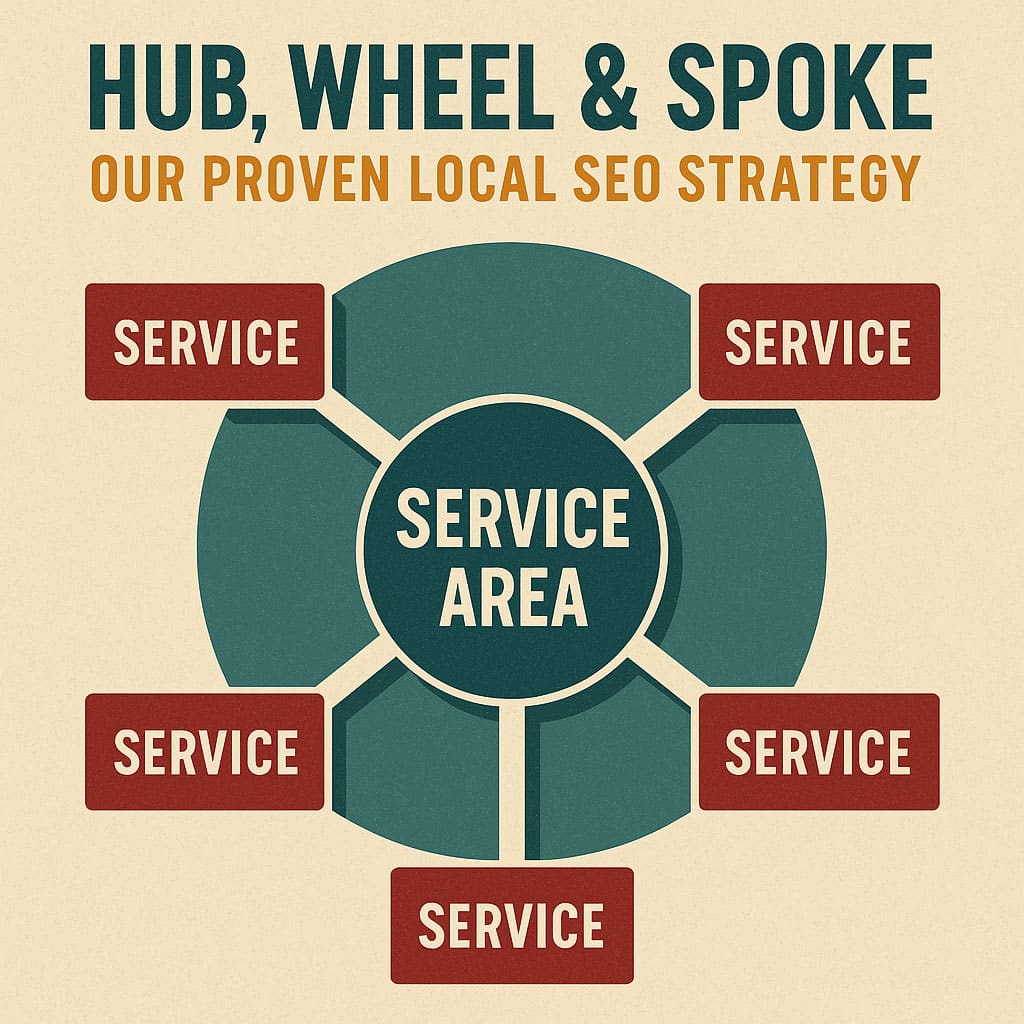
A hub and spoke content strategy organizes a website around central “hub” pages that cover a broad topic or location, supported by “spoke” pages that each cover one specific service or subtopic in depth, all connected by deliberate internal links. Instead of dozens of thin pages competing with each other, every page has one clear job, and every link passes authority to the pages that need it.
Our version adds the “wheel”: the internal linking layer that connects hubs to spokes and spokes to each other. The wheel is what turns a pile of pages into a system.
The common mistake: a page for every service in every city
We see it constantly. An agency builds dozens, sometimes hundreds, of nearly identical pages like /mesa/plumbing-repair, /chandler/plumbing-repair, /gilbert/plumbing-repair, with the city name swapped and everything else copy-pasted.
It looks like local coverage. It behaves like a liability:
- Duplicate content. Google recognizes copy-paste pages with city names swapped, and they rarely hold rankings.
- Keyword cannibalization. Multiple pages compete for the same terms, so Google can’t tell which one to rank, and often ranks none of them well.
- Wasted crawl budget. Googlebot spends time on pages with no unique value, delaying indexation of your best content.
- Short-term spike, long-term decline. A brief traffic bump, then a slow fade as the thin pages lose trust.
The stakes of getting structure wrong are real: Ahrefs’ research shows 96.55% of all pages get zero organic search traffic from Google (Ahrefs, 2026). Mass-produced doorway pages are exactly the kind of content that ends up in that 96.55%.
How the Hub, Wheel & Spoke structure works
The hubs: service-area pages
Each major city you serve gets one dedicated, content-rich page, like our own Gilbert and Mesa pages. These act as localized landing pages that showcase everything you offer in that market, built with local proof: testimonials from customers in that city, project photos from the area, and honest detail about how you serve it. The rule we hold ourselves to: every city hub must be substantially unique. If a page could describe any city by swapping the name, it isn’t done.
The spokes: service pages
Each core service gets its own evergreen, optimized page, /services/plumbing-repair, /services/drain-cleaning, and so on. Spoke pages go deep on the service itself: process explanations, FAQs, pricing context, real results, and conversion-focused calls to action. Depth wins here, and it compounds, Ahrefs found the average top-ranking page also ranks in the top 10 for nearly 1,000 other relevant keywords (Ahrefs, 2026). One genuinely deep service page can capture an entire keyword neighborhood that fifty thin pages never would.
The wheel: internal linking
Internal links connect hubs to spokes and back, so search engines crawl the site effectively, users move naturally between services and areas, and authority flows where it’s needed. This is the most underrated part of the system. In Search Engine Journal’s State of SEO 2026 survey of 371 professionals, 22.9% ranked internal linking strategy among their highest-impact SEO activities (SEJ, 2025). Anchor text matters too: Ahrefs cites Zyppy’s internal links study showing pages with at least one exact-match internal anchor had at least five times more traffic than pages without (Ahrefs, 2026).
We use descriptive, anchor-rich links and clean site architecture to reinforce every city-service combination, without duplicating a single page. Link building then multiplies the effect: every external link earned by any page strengthens the whole wheel.
What if you only have one Google Business Profile location?
The structure works especially well for single-location businesses that serve multiple nearby cities. Say you’re a Gilbert-based plumber serving Mesa, Tempe, and Chandler:
- Your Google Business Profile stays tied to your real Gilbert office, no fake addresses, no virtual offices.
- Your website ranks in surrounding cities through optimized service-area hub pages and strong internal linking.
- You avoid duplicate content entirely while still capturing “plumber near me” demand across your real service area.
This mirrors how we run our own two offices, Gilbert and Queen Creek, covering the East Valley through hub pages rather than shell listings.
Why does this structure work for AI SEO?
Because AI answer engines reward exactly what Hub, Wheel & Spoke produces: clear topical authority, unambiguous page purpose, and extractable answers. Semrush’s research found that over 88% of searches triggering AI Overviews have informational intent (Semrush, 2025), which means the informational depth on your spoke pages is what earns citations, while your hubs and conversion pages capture the searchers who click through. BrightEdge research adds a useful nuance for local businesses: local and purchase-intent searches trigger AI Overviews less often than informational ones (BrightEdge via SEJ, 2024), so your local hub pages continue competing in traditional results even as AI answers expand.
The structure also aligns with how Google evaluates E-E-A-T:
- Experience: localized, first-hand content on city hubs reads authentic because it is.
- Expertise: spoke pages go deep with original, helpful detail.
- Authoritativeness: internal linking reinforces a clear site hierarchy around your core topics, and 33.2% of SEO professionals now plan to invest in topical authority and content architecture (SEJ State of SEO 2026).
- Trust: one clean, organized site beats a bloated mess of near-duplicates.
This is the same architecture we teach in our AI SEO 2026 guide, applied to local service businesses.
How do you build a Hub, Wheel & Spoke system? (Our process)
- Map the market. We identify the cities you genuinely serve and the services worth their own page, using Semrush keyword data to size real demand.
- Build the spokes first. Deep service pages, one per core service, with FAQs and schema.
- Build the hubs. One unique service-area page per city, each with local proof and a minimum uniqueness standard.
- Connect the wheel. A deliberate internal linking map with descriptive anchors, every page links up to its hub, across to siblings, and out to supporting content.
- Measure and reinforce. GA4, Search Console, and Semrush position tracking tell us which hubs and spokes need more depth, links, or supporting blog content.
Build for users, and Google follows
We don’t run cookie-cutter SEO. The Hub, Wheel & Spoke method exists because we watched patchwork city-page strategies spike and collapse, and our clients needed something that compounds instead. If your rankings fade after every short-term traffic bump, or you’re staring at 200 near-identical city pages an old vendor built, let’s fix the architecture.
Book a content strategy conversation or explore our Arizona SEO services to see how we’d structure it for your market.
Frequently asked questions
What is a hub and spoke content strategy?
It’s a site structure that organizes content around central hub pages (broad topics or locations) supported by in-depth spoke pages (individual services or subtopics), connected by deliberate internal links. It builds topical authority while preventing duplicate content and keyword cannibalization.
How is Hub, Wheel & Spoke different from regular hub and spoke?
The “wheel” is the internal linking layer. Most hub-and-spoke advice stops at page organization; our method treats the linking map as a first-class deliverable, which pages link where, with what anchors, because that’s what moves authority through the site.
Do city service-area pages still work in 2026?
Yes, when each page is substantially unique and tied to a real service area. What no longer works is mass-producing near-identical city pages. Local searches also trigger AI Overviews less often than informational searches (BrightEdge via SEJ), so well-built local pages keep earning traditional clicks.
Does this structure help with AI Overviews?
Yes. AI systems cite sites that demonstrate clear topical authority and provide extractable answers. Deep spoke pages supply the informational content AI Overviews draw from, over 88% of AI Overview triggers are informational queries (Semrush), while hubs capture local, higher-intent searches.
Sources
- Search Engine Journal, State of SEO 2026 survey (n=371), searchenginejournal.com (22.9% internal linking impact; 33.2% topical authority investment)
- Ahrefs, “107 SEO Statistics for 2026”, https://ahrefs.com/blog/seo-statistics/ (96.55% of pages get zero Google traffic; top pages rank for ~1,000 other keywords; Zyppy 5x internal anchor finding)
- Semrush, “26 AI SEO Statistics for 2026”, https://www.semrush.com/blog/ai-seo-statistics/ (88%+ of AI Overview triggers are informational)
- BrightEdge research cited in Search Engine Journal, “SEO in the Age of AI” (2024), searchenginejournal.com (local/purchase-intent searches trigger AI Overviews less often)