By Mike Rux · Published August 6, 2024 · Updated July 31, 2026
TL;DR
- Web design and SEO are not separate projects. Site structure, speed, and layout stability are ranking inputs, and they decide whether visitors convert once they arrive.
- Only 33% of websites pass the Core Web Vitals threshold (Ahrefs, 2026), a well-built site is still a genuine competitive edge.
- 96.6% of all Google search clicks go to first-page results (Ahrefs), so design flaws that hold back rankings are expensive.
- In the AI search era, clean structure matters twice: it helps Google rank you and helps AI systems parse and cite you.
- When we rebuilt our own site with design and SEO planned together, we doubled our conversion rates.
It’s no secret that a website’s success depends on both its design and its search engine optimization. What many businesses miss is that these two disciplines have to be planned together, not bolted onto each other after launch. A gorgeous site nobody finds is a brochure in a drawer. A high-ranking site that’s confusing to use just generates expensive bounces.
We’ve built and rebuilt enough websites, including our own, to say this plainly: design decisions are SEO decisions. Here’s how the two work together, and what it looks like when they do.

How Does Web Design Affect SEO?
Web design affects SEO through page speed, mobile layout, site structure, and layout stability, all signals Google measures through Core Web Vitals and crawling. A slow, unstable, or confusing design suppresses rankings and conversions at the same time; a fast, well-structured design lifts both.
The numbers back this up. Only 33% of websites pass the Core Web Vitals threshold, and 72.3% of websites have slow pages, according to Ahrefs’ 2026 SEO statistics roundup. That means most of your competitors are shipping sites that fail Google’s own performance bar. Meanwhile, 42.3% of SEO professionals say technical SEO enhancements delivered their greatest positive impact over the past year (Search Engine Journal, State of SEO 2026 survey of 371 professionals). Design and development are where those technical wins live.
And the stakes are concrete: 96.6% of all Google search clicks go to results on the first page (Ahrefs). If design problems keep you off page one, they’re not cosmetic, they’re a lead-generation problem.
What Does SEO-Friendly Web Design Actually Include?
An SEO-friendly design is one where visual appeal, performance, and search structure were engineered together. In practice, that means a WordPress build that keeps visitors on the site and gives Google clean signals to rank. When our team designs a site, these items are on the blueprint before a single mockup is approved:
- Speed budget. Caching, image compression, and a low-bloat theme decided up front, not patched later. (We run Genesis + WP Rocket on our own site for exactly this reason.)
- Mobile-first layout. Buttons and forms sized for thumbs, layouts that don’t jump, see our post on cumulative layout shift for why stability is its own ranking signal.
- Crawlable structure. Logical headings, internal links between related pages, and clean URLs.
- Conversion paths. Every page has one obvious next step, call, text, or book.
- Schema and answer-ready content. Structured data and clear, direct copy that AI systems can parse. Semrush’s research puts it simply: “Strong SEO fuels AEO”, sites with authority and clean structure are the ones AI answers cite.
That last point is the 2026 twist. Roughly 60% of searches on traditional search engines now end without any clicks (Semrush, citing Bain & Company), so the sites that win are the ones structured clearly enough to be both ranked and cited. Design sloppiness now costs you in two channels at once.
Our Own Case Study: Doubling Conversions With SEO-Focused Design
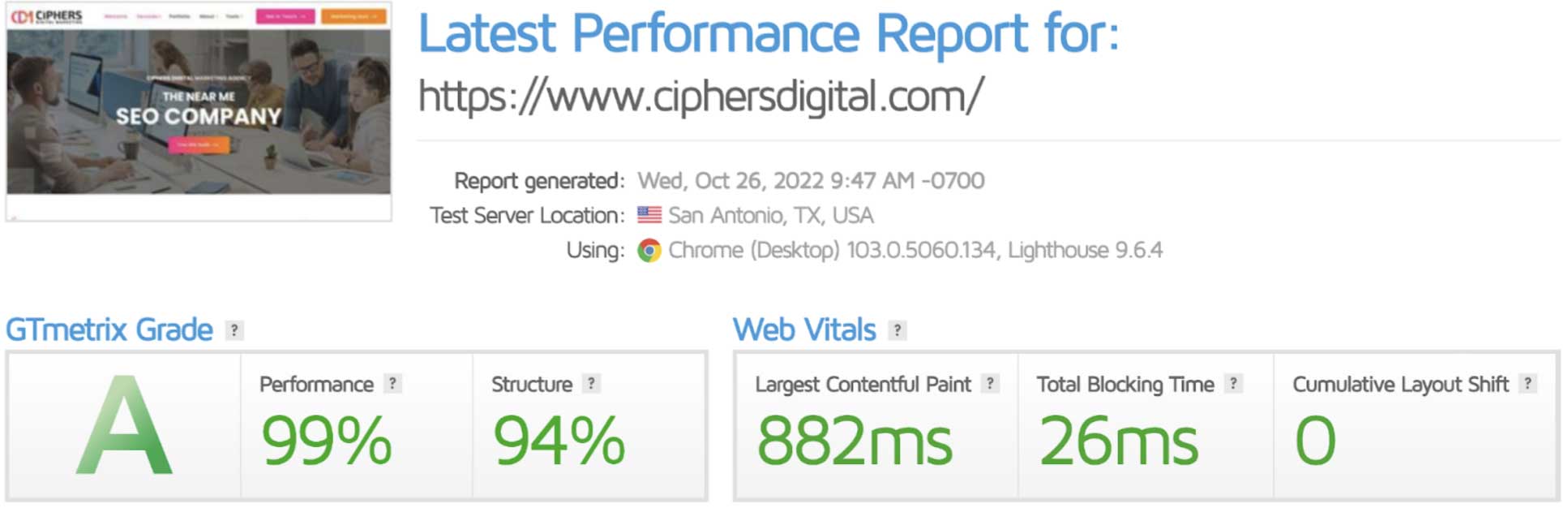
Ciphers Digital Marketing is an SEO-focused agency based in Gilbert, Arizona, and we treated our own website as the test bench. “Since working on our own website, we have doubled conversion rates just with the visual design. We like how the new website design is clean and easy to navigate, while focusing on web development, the speed and functionality of the website.” – Mike Rux, owner of Ciphers Digital Marketing.
Under the hood, the build followed the same rules we give clients: a low-bloat WordPress backend and a conversion-focused interface. “Our coding team identified the best caching settings, server configuration and holistic WordPress framework and plugin soup. These elements paired with clean WordPress development and coding, created a high performing website with high conversion rates.” – Richard P., Ciphers Digital web dev team.
We’ve since applied the same design-plus-SEO playbook for clients, like the garage door company in our garage doors SEO and web design case study, where the redesign and the SEO campaign were one project, not two.
Should SEO Come Before or After Web Design?
SEO should come before and during web design, not after. Keyword research decides your page list and site architecture; technical SEO sets your performance budget; and content strategy shapes the layout of every template. Retrofitting SEO onto a finished design usually means redesigning twice and paying twice.
Here’s the working order we follow on every build:
| Phase | SEO input | Design output |
|---|---|---|
| Research | Keyword map, competitor gaps | Page list and site architecture |
| Wireframe | Search intent per page | Layout, headings, CTA placement |
| Build | Performance budget, schema plan | Fast, crawlable WordPress build |
| Launch | Redirects, Search Console, GA4 | Clean handoff, no lost rankings |
| Ongoing | Core Web Vitals monitoring | Iterative design fixes |
Can a Website Redesign Hurt My SEO?
Yes, a redesign can hurt SEO if URLs change without redirects, content gets thinned out, or the new build is slower than the old one. Rankings you spent years earning can drop within weeks. The fix is planning: preserve URLs where possible, map redirects for anything that moves, and benchmark speed before and after.
This is the single most common emergency call we get: “We launched a beautiful new site and our traffic disappeared.” It’s preventable. If a redesign is on your roadmap, get an SEO review of the plan before the old site comes down, our web design team does this as a standard step.
Getting Design and SEO Working Together on Your Site
You don’t need to start over to benefit from this. Start with three checks: run your site through PageSpeed Insights, click through your own mobile experience like a first-time customer, and search your main service in Google to see where you actually stand. If any of those three make you wince, design and SEO probably aren’t working together yet.
Ciphers Digital has 15+ years in the Gilbert community and a combined process that treats design, development, and SEO as one build. If you’d like the framework we use, and reporting you can actually read, reach out for a free consultation, or keep reading on The Digital Climb.
Sources
- Ahrefs, “107 SEO Statistics for 2026”, https://ahrefs.com/blog/seo-statistics/ (Core Web Vitals pass rate, slow pages, first-page click share)
- Search Engine Journal, State of SEO 2026 survey (n=371, 52 countries), searchenginejournal.com (technical SEO impact)
- Semrush, “26 AI SEO Statistics for 2026,” citing Bain & Company, https://www.semrush.com/blog/ai-seo-statistics/ (zero-click share)
- Semrush, “AEO vs SEO: Core Differences”, https://www.semrush.com/blog/aeo-vs-seo/ (“Strong SEO fuels AEO”)