By Mike Rux · Published November 2, 2025 · Updated July 31, 2026
TL;DR, Key takeaways
- Using AI in marketing is ethical when it’s disclosed, human-reviewed, and used to serve clients better, not to mass-produce filler or fake results.
- AI adoption is near-universal: only 2.6% of marketing decision-makers report using no AI tools at all (SEJ State of AI in Marketing survey).
- The biggest AI risk is accuracy: 54.2% of marketers say inaccurate or inconsistent output is AI’s top limitation, and 62.6% name AI-generated misinformation as their biggest concern.
- The industry is converging on our model: 58.5% of SEO professionals plan human-authored content supported by AI, versus 22.4% pursuing primarily AI-generated content.
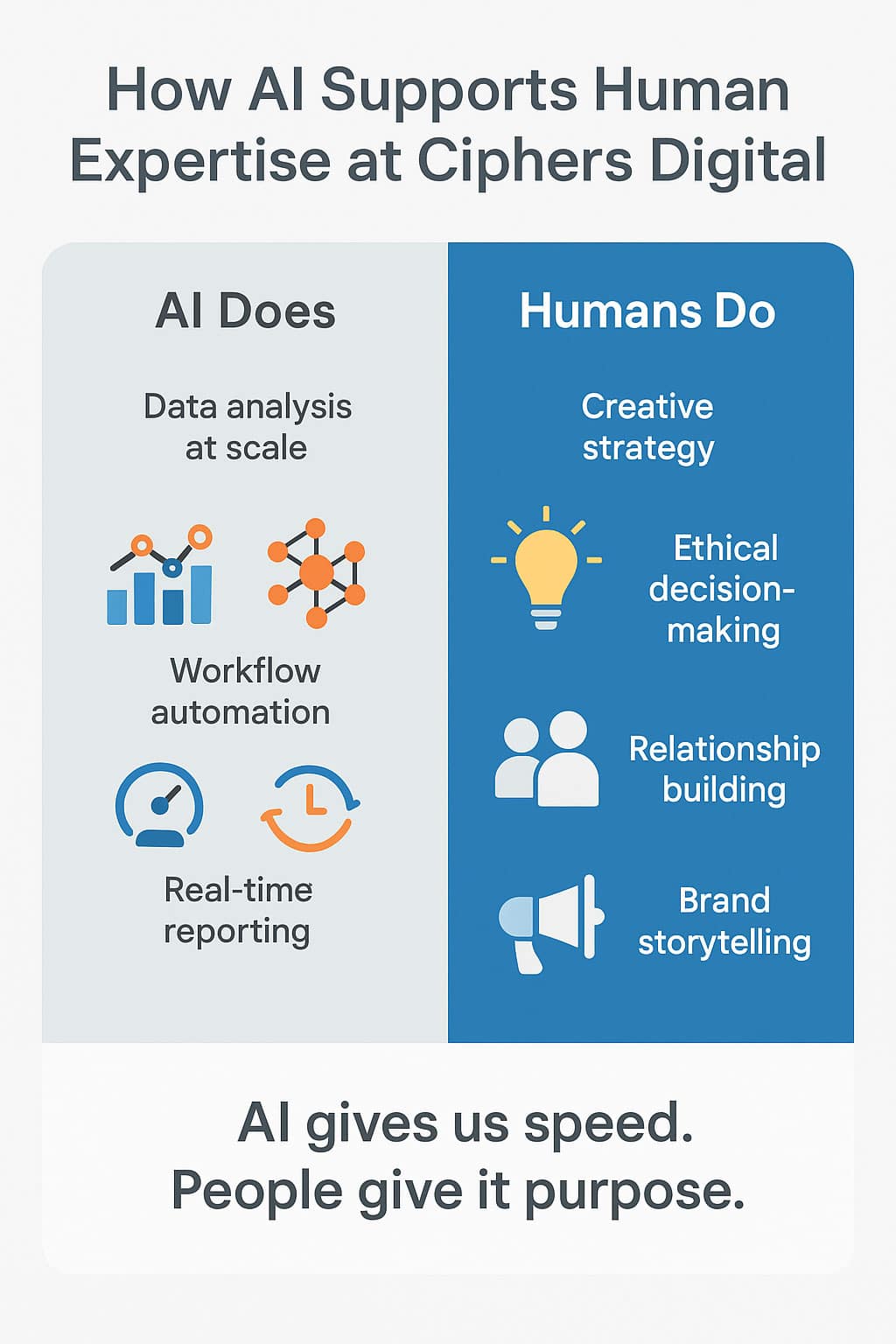
- At Ciphers Digital Marketing, AI gets horsepower; humans keep the wheel. Every recommendation passes through our team’s judgment before it touches your business.
At Ciphers Digital Marketing, we’ve always believed growth comes from doing things the right way: treating clients like partners, putting quality before shortcuts, and backing every strategy with real data. That philosophy hasn’t changed. The tools have. AI now lets us analyze data faster, spot opportunities earlier, and execute with more precision, but AI doesn’t replace integrity, creativity, or work ethic. It just gives them more horsepower.
Is it ethical to use AI in marketing?
Yes, when it’s used transparently, reviewed by humans, and applied to genuinely help customers rather than mislead them. AI becomes unethical in marketing when it fabricates claims, impersonates people, hides its role in deceptive ways, or floods the web with unreviewed content nobody stands behind. The tool is neutral; the practices around it are what earn or break trust.
That’s not a fringe worry. In Search Engine Journal’s State of AI in Marketing survey of 155 U.S. marketing decision-makers, 62.6% said AI-generated misinformation is their biggest concern about rapid AI adoption, and 32.9% flagged ethical or legal risks specifically (SEJ, 2025). The concern is justified by the tools’ track record: 54.2% of marketers say inaccurate, unreliable, or inconsistent output quality is AI’s biggest limitation (SEJ, 2025).
Our answer to both problems is the same: nothing AI produces ships to a client, a campaign, or a website without a human who knows your business reviewing it first.
How does Ciphers Digital use AI the right way?
We use AI to assist our workflow, not to automate our values. In practice, AI helps our team:
- Brainstorm content angles and keyword ideas faster
- Spot market trends and ranking shifts before competitors react
- Draft initial SEO outlines and campaign concepts
- Audit large datasets, Semrush exports, GA4 behavior, backlink profiles, and surface opportunities quicker
Then every recommendation runs through a human filter: our team’s judgment, 15+ years of experience in the Gilbert market, and a working knowledge of your actual customers. No algorithm understands empathy, tone, or long-term trust like the person who answers your account calls. This is the same human-plus-AI model we apply across our SEO campaigns and content marketing work.
The industry data backs the split. Marketers report AI’s biggest verified win is speed, 76.8% cite time savings as the outcome AI most improved, while only 7.1% report improved lead quality from AI alone (SEJ, 2025). AI buys time. Humans convert that time into strategy.
Why do ethics beat algorithms?
Because shortcuts show up in the results. We’ve all seen what happens when agencies chase trends and use automation to pump out generic deliverables: content nobody reads, reports nobody understands, and rankings that evaporate at the next algorithm update. Quality still reads differently, in an Ahrefs survey, 65% of respondents said human-written content is better quality than AI-generated content (Ahrefs, 2026).
What we commit to instead:
- Honest communication. If something isn’t working, you hear it from us first.
- Measurable progress. Real numbers in reporting you can read, no smoke and mirrors.
- Transparent use of AI. We’ll tell you where AI assists our process and where humans own it.
- Client-first calls. Doing what’s best for the client, even when it takes longer.
What does ethical AI mean for our clients?
It means enterprise-grade efficiency with local-agency accountability. With AI as the assistant and data as the guide, clients get:
- SEO strategies built on research, not guesswork, including AI SEO and answer engine optimization that positions you inside AI-generated answers honestly
- Local and organic campaigns that grow real visibility
- Google Ads management that cuts wasted spend
- Human-written, conversion-focused copy, supported by AI research, never replaced by it
That combination is where the industry is heading, not just where we sit: 58.5% of SEO professionals plan to focus on human-authored content supported by AI tools over the next year, versus only 22.4% pursuing primarily AI-generated content (SEJ State of SEO 2026, n=371). We just got there early.
The future is human-powered, AI-assisted
Ciphers Digital isn’t an “AI agency.” We’re a people-first digital marketing company that uses technology to amplify what we do best: helping real businesses grow. Practically everyone now has the same tools, only 2.6% of marketing decision-makers report using no AI at all (SEJ, 2025). The differentiator isn’t access to AI. It’s the judgment, ethics, and accountability wrapped around it.
AI helps us think faster. Integrity keeps us thinking long-term. If you want a partner who treats both as non-negotiable, meet our team or get in touch: call or text (602) 844-8072.
Frequently asked questions
Is it ethical to use AI in marketing?
Yes, when AI is used transparently, its output is reviewed by accountable humans, and it’s applied to serve customers rather than mislead them. It becomes unethical when used to fabricate claims, deceive audiences, or publish unreviewed content at scale.
Does Ciphers Digital use AI to write client content?
We use AI for research, outlines, data analysis, and idea generation. Final strategy and client-facing copy are human-written and human-approved. This mirrors the dominant industry approach: 58.5% of SEO professionals plan human-authored content supported by AI tools (SEJ State of SEO 2026).
What are the biggest risks of AI in marketing?
Accuracy and misinformation. 54.2% of marketers cite inaccurate or inconsistent output as AI’s top limitation, and 62.6% name AI-generated misinformation as their biggest adoption concern (SEJ State of AI in Marketing, n=155). Human review is the control for both.
Will AI replace marketing agencies?
The data says no, it’s reshaping them. Only 4.5% of organizations reduced their marketing team due to AI, and just 18.7% of marketers rank “decreased need for human marketers” as their top concern (SEJ, 2025). AI removes busywork; strategy, ethics, and relationships stay human.
Sources
- Search Engine Journal, State of AI in Marketing survey (n=155 U.S. marketing decision-makers, May 2025), searchenginejournal.com (2.6% no-AI; 62.6% misinformation concern; 54.2% accuracy limitation; 76.8% time savings; 7.1% lead quality; 4.5% team reductions; 18.7% job concern; 32.9% ethical/legal risk)
- Search Engine Journal, State of SEO 2026 survey (n=371, 52 countries), searchenginejournal.com (58.5% human-authored with AI support vs 22.4% AI-generated)
- Ahrefs, “107 SEO Statistics for 2026”, https://ahrefs.com/blog/seo-statistics/ (65% say human-written content is better quality)