By Mike Rux · Published August 6, 2024 · Updated July 31, 2026
TL;DR
- AI chatbots are worth it for most small businesses in 2026, if they’re trained only on your approved content and wired to capture leads, not just chat.
- Adoption is effectively settled: only 2.6% of marketing decision-makers report not using any AI tools (SEJ, State of AI in Marketing survey).
- The #1 risk is also settled: 54.2% of marketers say inaccurate or inconsistent output is AI’s biggest limitation. Guardrails aren’t optional.
- The hidden bonus: every question your bot can’t answer is a content gap. Answer it on your site and you’ve improved your SEO and your bot at once.
- We build client chatbots on Botpress with OpenAI models, restricted to the client’s own content, with lead capture built into the conversation flow.
Ready to bring your customer service up to date? An AI chatbot that handles questions using generative AI may be the most practical AI investment a small business can make, it works your website 24/7, answers the questions your visitors actually have, and hands you the lead when the conversation gets serious. Customers have already voted with their thumbs: ChatGPT now has 700 million weekly active users, making it the fourth most visited website globally (Semrush, citing OpenAI). People are comfortable talking to AI. The question is whether they can talk to yours.
At Ciphers Digital Marketing we build client chatbots on Botpress using OpenAI’s models, and this post covers what we’ve learned: where bots earn their keep, where they embarrass you, and how the build actually works.
Are AI Chatbots Worth It for Small Business?
AI chatbots are worth it for most small businesses in 2026, provided two conditions are met: the bot is trained only on your approved business content so it can’t invent answers, and it’s designed to capture leads, not just deflect questions. Under those conditions, a chatbot delivers after-hours coverage, faster response times, and a steady record of what customers actually ask.
The adoption question has answered itself, only 2.6% of marketing decision-makers report not using any AI tools at all (Search Engine Journal, State of AI in Marketing survey of 155 US decision-makers), and 83.2% say ChatGPT has helped their marketing effectiveness more than any other AI tool. Your customers use this technology daily; 77% of ChatGPT users in the USA treat it like a search engine (Semrush, citing Adobe). A chatbot on your site meets an expectation that already exists.
The honest caveat: a bad chatbot is worse than none. Which brings us to the risk section, because we’d rather you hear it from us.
What Are the Risks of AI Chatbots?
The main risks of AI chatbots are inaccurate answers, off-brand tone, and frustrating loops that block visitors from reaching a human. In Search Engine Journal’s State of AI in Marketing survey, 54.2% of marketers named inaccurate, unreliable, or inconsistent output as AI’s biggest limitation, and 62.6% said AI-generated misinformation is their top concern about rapid AI adoption.
All three risks trace to one root cause: an unrestricted bot improvises. The fix is scope. A well-built business chatbot is:
- Trained on a closed knowledge base: your website, your service docs, your FAQ, and nothing else.
- Honest about its limits: when it can’t find an answer, it says so and offers a human handoff, instead of guessing.
- Tone-controlled: it speaks the way your business speaks, and it treats your customers with respect.
- Escapable: a phone number, text option, or contact form is always one tap away.
This is why we’re picky about the build platform and the training scope, and why we wrote a whole post on ethical AI in digital marketing. AI should be doing honest work for your business, not making promises your team never approved.
How We Build Business Chatbots (Botpress + OpenAI)
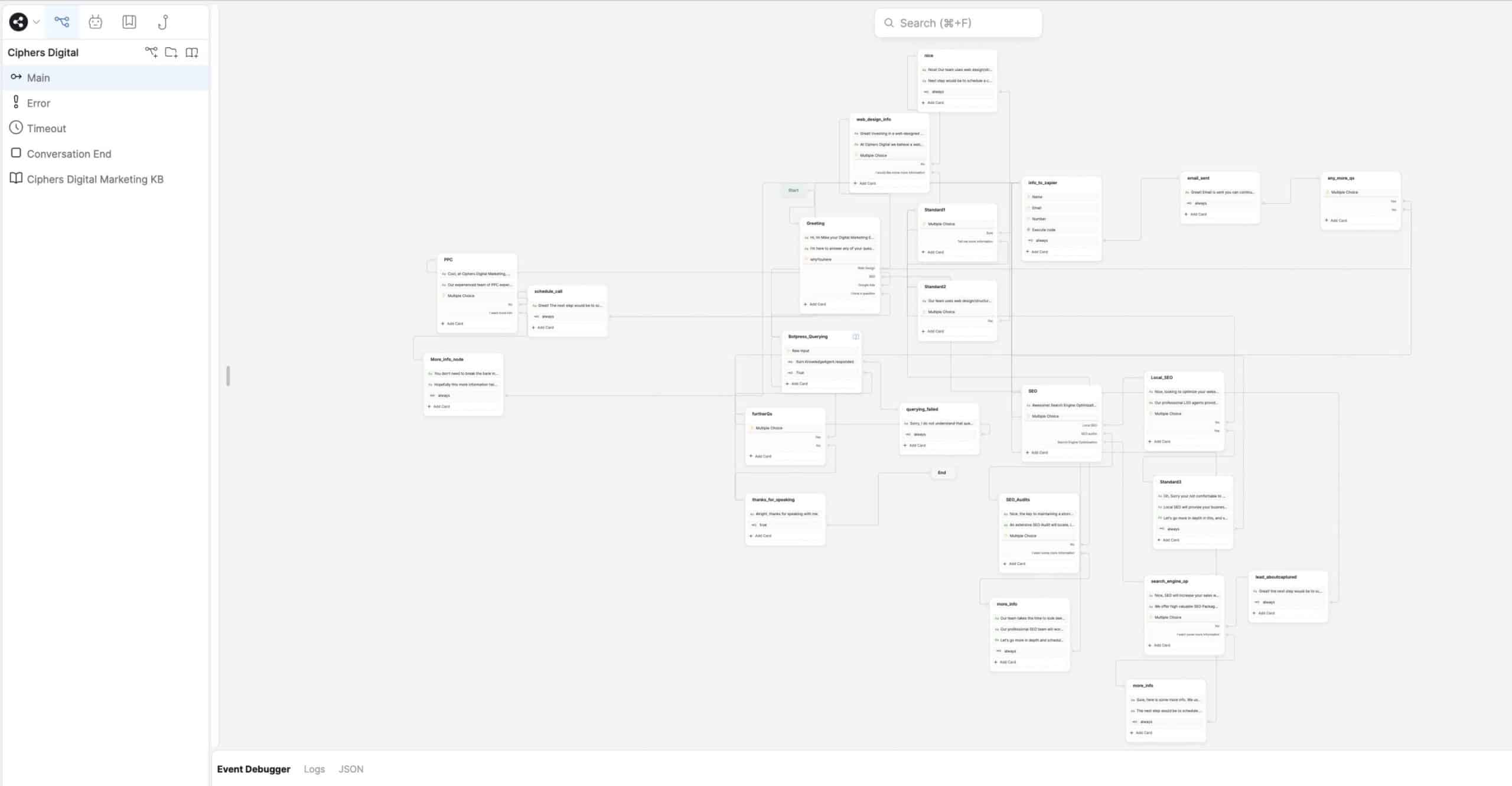
Our chatbot builds run on Botpress, powered by OpenAI models, with workflow commands that control exactly where the bot looks for answers. The platform is free to start with a pay-as-you-go model, which keeps the pilot phase affordable for small businesses.
The build process, in plain terms:
- Define the jobs. Which questions should this bot own? Services, pricing ranges, service areas, scheduling, hours. We map these from your real inquiry history.
- Restrict the sources. We command the bot to answer only from your website and approved documents. Example: if the answer isn’t on your site, the bot politely says it doesn’t have that information and offers to connect the visitor with your team.
- Design the lead capture. When a conversation shows buying intent, someone asks about pricing or availability, the bot asks for a name, phone, or email, and stores it for follow-up. The bot isn’t just a knowledge base; it’s a lead generation tool that qualifies inquiries while you sleep. (If lead gen fundamentals are new territory, start with what is lead generation.)
- Test rudely. We try to break the bot, misspellings, weird phrasing, questions it shouldn’t answer, before your customers do.
- Review the transcripts monthly. This is where the compounding value lives, as the next section explains.
How AI Chatbots Quietly Improve Your SEO
Every question your chatbot can’t answer is a content gap on your website, and filling those gaps improves your search visibility along with your bot. When the bot logs an unanswered question, we add the answer to your site as an FAQ. Next time, the bot finds it. Meanwhile, Google and AI search engines find it too.
This loop matters more than ever. Over 88% of searches that trigger Google AI Overviews are informational (Semrush AI Overviews study), exactly the kind of question-and-answer content your chatbot transcripts hand you for free. Your customers are literally telling you what to publish. Few keyword tools are that direct. Structured well, those answers can earn rich results and AI citations, which is bread-and-butter work for our SEO team.

What Can a Well-Trained Chatbot Actually Do?
Trained properly, a business chatbot wears several hats:
- Answer detailed questions about your services and products, accurately, from your own content.
- Explain your process and pricing to the level you’ve approved, and no further.
- Funnel visitors to action: guiding them to the right page, form, or booking link.
- Capture and qualify leads with contact details stored for same-day follow-up.
- Hold a genuinely human-quality conversation: the part modern generative AI does startlingly well, as long as the guardrails hold.
What it shouldn’t do: replace your humans. The data says businesses aren’t doing that anyway, only 4.5% of organizations reduced their marketing team due to AI (SEJ, State of AI in Marketing). The winning pattern is augmentation: the bot handles the 2 a.m. “do you service Queen Creek?” questions, and your team handles the judgment calls.
Getting Started Without Getting Burned
Start small: one bot, one job, trained on your existing site content, with lead capture and a human handoff. Pilot it for a month, read every transcript, then expand what it’s allowed to answer. That sequence keeps the risk near zero and shows you real ROI data, your own, not a vendor’s slide deck.
We build these as part of client web development projects and as standalone additions. If you want a chatbot that helps customers and captures leads, without the improv act, get in touch with Ciphers Digital, or call or text (602) 844-8072. More AI-for-business guides live on The Digital Climb.
Sources
- Semrush, “26 AI SEO Statistics for 2026,” citing OpenAI and Adobe, https://www.semrush.com/blog/ai-seo-statistics/ (ChatGPT weekly users, AI Overviews informational intent)
- Semrush, “AEO vs SEO: Core Differences,” citing Adobe, https://www.semrush.com/blog/aeo-vs-seo/ (ChatGPT used as a search engine)
- Search Engine Journal, State of AI in Marketing survey (n=155 US decision-makers, May 2025), searchenginejournal.com (AI adoption, ChatGPT effectiveness, output-quality limitation, misinformation concern, team impact)

